

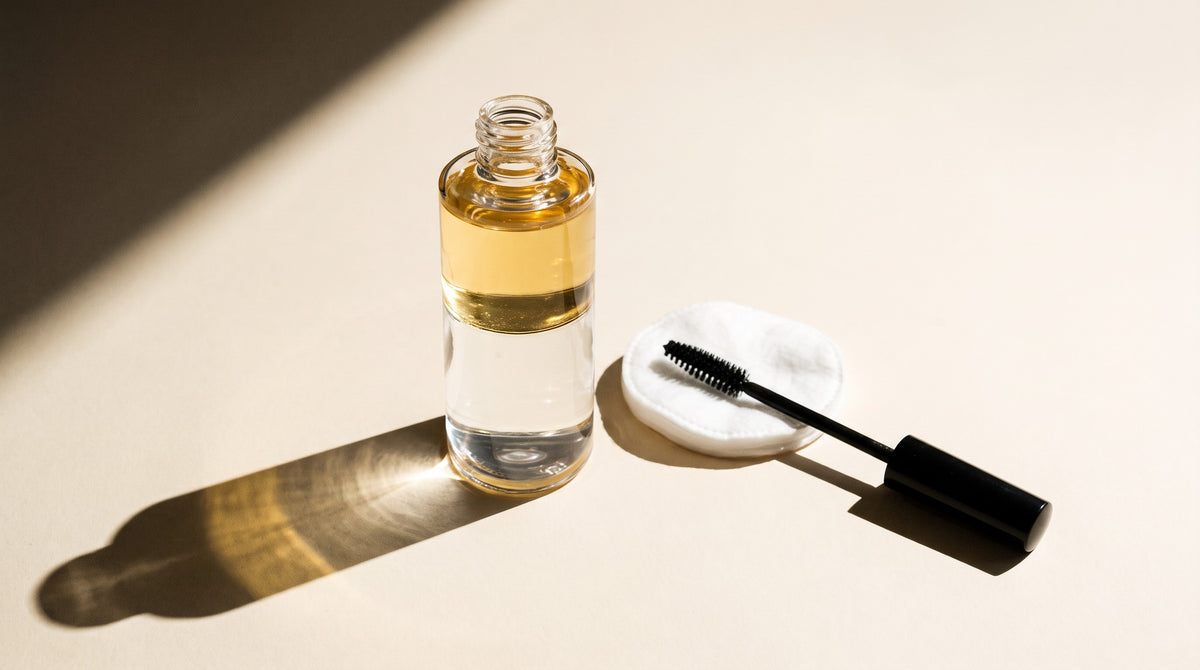
Waterproof mascara is designed to survive rain, sweat and tears. That is exactly why it refuses to budge at the end of the day — and why so many people end up rubbing, tugging and quietly losing lashes over the sink. It does not have to be that way. Once you understand what makes a waterproof film waterproof, removing it becomes a 30-second job instead of a battle.
Why waterproof mascara resists water
Regular mascara is largely water-based. Waterproof mascara is not. It is built on film-forming polymers and waxes suspended in volatile solvents: once the solvent evaporates on your lashes, what is left behind is a flexible, water-repelling film wrapped around each hair. Water alone cannot dissolve it, because the film was engineered not to be dissolved by water.
This is why a splash of water and a foaming cleanser leaves you with grey smudges under the eyes. You are not using the wrong amount of effort — you are using the wrong chemistry. Waterproof films are lipophilic: they let go of an oil, not of water. That single fact explains almost everything about eye makeup removal.
Does micellar water remove waterproof mascara?
Partly — and it is worth being honest about where the limit is.
Micellar water works through micelles: tiny clusters of surfactant molecules that trap oil and dirt in their centre and carry them away on a cotton pad. It is genuinely excellent at lifting sebum, sunscreen, everyday foundation and standard mascara, and it does it without stripping, which is why a no-rinse micellar water such as our Micellar Cleansing Water with aloe vera and hyaluronic acid has become a staple step.
But a micellar water is still predominantly water. Against a fully waterproof film it usually needs several passes, more pressure and more time on the lashes — and pressure and time around the eye are exactly what you want to avoid. If you wear waterproof mascara or long-wear liner, micellar water is a good general cleanser but not the most efficient tool for that one job.
What is a biphasic makeup remover?
A biphasic makeup remover — sometimes written bi-phase or two-phase — solves the problem by refusing to choose between oil and water. In the bottle the two layers sit visibly separated: a lighter oil phase floating above a clear water phase. You shake it, the phases combine into a temporary emulsion, and for the next minute you have a fluid that can address both kinds of makeup at once.
The oil phase goes after the waterproof film, the waxes and the long-wear pigments. The water phase handles everything water-soluble and keeps the whole thing from feeling greasy. Because the oil is doing the dissolving, you do not have to supply friction — the film releases on contact rather than being scrubbed off.
Our BiPhasic Make-up Remover is built on that principle. Sunflower seed oil and coconut alkanes make up the dissolving side; aloe vera juice and chamomile extract calm the skin around the eyes; sodium hyaluronate and glycerin replenish moisture so skin is not left tight afterwards; and sea buckthorn and raspberry fruit extracts add antioxidants. It is ophthalmologically tested for use around the eyes and suits all skin types, including sensitive or reactive skin. No rinsing is needed.
How to remove waterproof mascara, step by step
- Shake the bottle. With a biphasic formula this is not optional — unshaken, you are applying one phase or the other, not both.
- Saturate a cotton pad properly. A barely damp pad is the single most common reason removal turns into rubbing. Use enough product that the pad is visibly wet.
- Press and hold for 15–20 seconds. Close the eye, lay the pad over the lashes, and wait. This is where the work happens. You are giving the oil phase time to break down the film.
- Sweep downwards, in the direction the lashes grow. One slow stroke, no back-and-forth scrubbing.
- Repeat once if needed, with a fresh pad. Two patient passes beat ten impatient ones.
- For the lash line and inner corners, fold the pad or use a cotton bud dipped in the remover for precision.
If you still see a grey tinge on the pad after the second pass, that is normal — it is residual pigment, not a sign the product failed.
Micellar water vs biphasic remover vs cleansing milk
These three are not competitors so much as tools for different jobs. Here is how they compare:
| Micellar water | Biphasic remover | Cleansing milk / oil-to-milk | |
|---|---|---|---|
| Best for | Everyday makeup, sebum, a quick refresh | Waterproof mascara, long-wear liner and lip colour | A full face of makeup and SPF, dry or sensitive skin |
| Texture | Watery, weightless | Two layers, shaken to combine | Milky or oil-to-milk |
| Rinsing | No rinse needed | No rinse needed | Usually rinsed or tissued off |
| Friction required | Moderate on waterproof makeup | Minimal | Minimal |
| Positine option | Micellar Cleansing Water | BiPhasic Make-up Remover | Sensitive Skin Oil-To-Milk Cleanser or Gentle Cleansing Milk |
Most people end up owning two: something for the eyes and something for the face.
Removing eye makeup with sensitive eyes or contact lenses
Sensitivity around the eye is usually a friction problem before it is an ingredient problem. Thin skin plus repeated rubbing produces redness, stinging and, over time, slackness — so the gentlest remover is the one that needs the least mechanical work, which is generally an oil-containing formula with good dwell time.
A few practical habits help:
- Take contact lenses out before removing eye makeup, not after, so nothing is trapped against the lens.
- Keep the product on the lashes and lash line rather than the inner rim.
- Choose a remover that has been ophthalmologically tested, and patch test anything new on the inner forearm first.
- If your eyes are already irritated, give them a night off from eye makeup rather than a gentler removal routine.
Persistent stinging, swelling or irritation is not something a product change should be asked to solve — see a pharmacist, doctor or eye-care professional.
Do you still need to cleanse afterwards?
Yes, and this is the step most routines skip. A no-rinse remover is designed to lift makeup, not to cleanse the skin underneath it. Removing makeup first and then cleansing is the whole idea behind double cleansing: the first step dissolves what is sitting on the skin, the second clears what is in the pores.
In practice: remover on a cotton pad for eyes and lips, then a cleanser over the whole face. If you wear sunscreen daily — and you should — an oil-to-milk cleanser handles SPF far better than a foaming wash on its own. Our guide to evening rituals for better skin walks through the full order.
Four mistakes that cost you lashes
- Rubbing side to side. Lashes sit in fragile follicles. Lateral friction is what pulls them out.
- Using a dry or half-dry pad. Under-saturating the pad forces you to compensate with pressure.
- Skipping the dwell time. Fifteen seconds of patience replaces a minute of scrubbing.
- Sleeping in it "just this once". Mascara left overnight flakes into the eye and stiffens lashes, making the next removal harder still.
Frequently asked questions
Can I use coconut oil or olive oil instead?
They will dissolve the film, but plain kitchen oils leave a heavy residue, can blur vision if they migrate into the eye, and are not formulated or tested for ophthalmic contact. A purpose-built remover does the same job cleanly.
Why does my biphasic remover look separated?
Because it is supposed to. Separation is the format working as designed — shake before every use.
Does a biphasic remover leave an oily film?
A well-balanced one should not. The water phase carries the oil phase away with the makeup, which is why our formula is made to be used without rinsing.
Is micellar water enough on its own?
For a light day of makeup, often yes. For waterproof mascara, long-wear liner or transfer-proof lip colour, an oil-containing remover will get you there with far less friction.
How often should I remove eye makeup this thoroughly?
Every day you wear it. Consistency matters more than intensity.
The short version
Waterproof mascara comes off with oil and patience, not water and pressure. Saturate the pad, press and hold, sweep once downwards, then cleanse the face properly afterwards. Your lashes will notice the difference long before your skin does.
This article is for general education and is not medical advice. If you have an eye condition, persistent irritation or a known allergy, speak to a qualified healthcare professional before changing your routine.
Share:
Does Kojic Acid Soap Actually Work? Rinse-Off vs Leave-On