

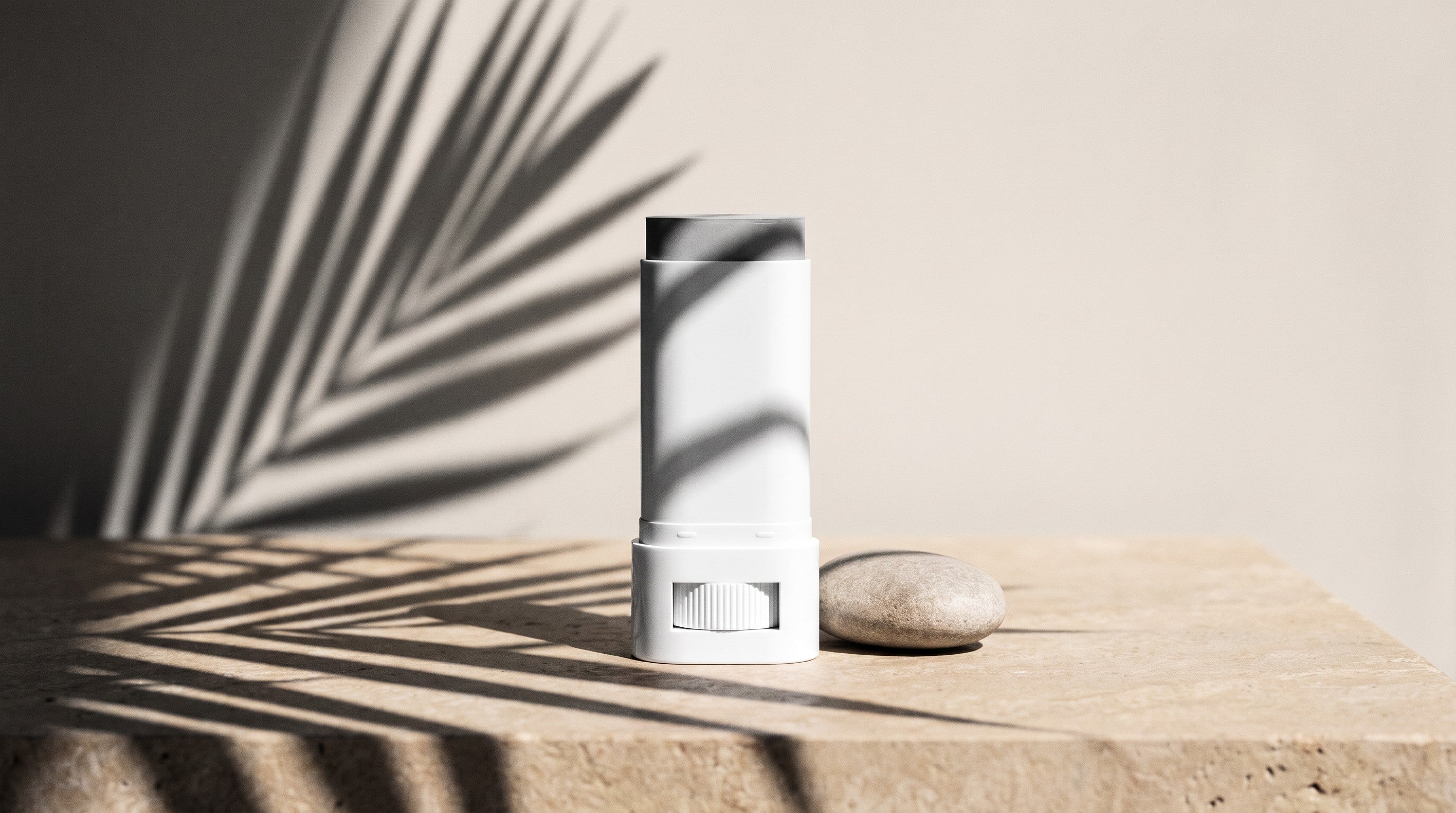
Mineral sunscreen has one famous drawback: the white cast. Tinted mineral sunscreen was created to solve exactly that problem — and if you have ever hesitated between a tinted and an untinted formula, or wondered whether a sunscreen stick can really protect as well as a lotion, this guide walks through what the tint actually does, who benefits from it, and how to apply a stick correctly.
What is tinted mineral sunscreen?
Tinted mineral sunscreen is a physical (mineral) sunscreen — typically based on zinc oxide — that also contains mineral pigments, most commonly iron oxides. The zinc oxide sits on the surface of the skin and reflects and absorbs UVA and UVB rays, while the pigments give the formula a soft, skin-like tone instead of a chalky white finish.
In other words: the sun protection comes from the mineral UV filter, and the tint is there for the finish. A well-made tinted formula, like our Sun Protection SPF50 Stick with Tint, uses zinc oxide together with pure mineral pigments to leave a soft, even finish with a subtle glow — no white cast.
Why does mineral sunscreen leave a white cast?
Zinc oxide and titanium dioxide are white minerals. When they are spread across the skin in a protective layer, some of that whiteness stays visible — which is precisely why mineral sunscreen is so often associated with a pale, ashy film, especially on medium and deep skin tones and in photos with flash.
There are two common ways formulators deal with this: making the mineral particles smaller, or adding pigments that counteract the white tone. A tinted mineral sunscreen takes the second route — the mineral pigments blend the white filter into the skin, so the protective layer becomes invisible while remaining just as protective.
Tinted vs untinted mineral sunscreen: which should you choose?
Both protect the same way; the difference is the finish. A quick comparison:
| Tinted mineral sunscreen | Untinted mineral sunscreen | |
|---|---|---|
| UV protection | Broad-spectrum UVA/UVB (zinc oxide) | Broad-spectrum UVA/UVB (zinc oxide) |
| Finish | Subtle, skin-evening glow; no white cast | Natural finish; may look slightly white on deeper skin tones |
| Best for | Face and visible areas, make-up-free days, deeper skin tones | Body, children's routines shared by the family, layering under make-up |
| Positine option | SPF50 Stick, with tint | SPF50 Stick, no tint |
Choose tinted if you want your sunscreen to double as a light skin-evening step and you dislike any hint of whiteness. Choose untinted if you prefer a completely neutral product you can use anywhere, on any family member, without transferring tint onto clothing or towels.
Are sunscreen sticks effective?
Yes — the stick is a format, not a compromise. What matters is the SPF rating, broad-spectrum protection and, above all, how the product is applied. A stick has some practical advantages:
- Precision: it glides exactly where you need it — nose, cheekbones, ears, hairline — without running into the eyes.
- Portability: a solid stick is mess-free, spill-proof and easy to carry, which makes the recommended reapplication every two hours far more realistic.
- No wasted product: nothing leaks or oxidises in an open tube.
The one thing to watch with any stick is coverage: because you are not dosing it into your palm, you need enough passes to build a proper protective layer.
How to apply a sunscreen stick correctly
- Apply generously — glide the stick over each area of the face several times, in slightly overlapping strokes, so the skin is visibly covered.
- Smooth it in with clean fingertips if you like a more blended finish.
- Don't forget ears, the back of the neck, and the tops of the shoulders.
- Reapply every two hours, and immediately after swimming, sweating or towel drying.
Our SPF50 sticks pair zinc oxide with nourishing plant oils — organic jojoba, sea buckthorn, rice bran and cocoa butter in the tinted version — so reapplication also feels like skincare: hydrating, non-comedogenic and suitable for sensitive skin. You can find both in our mineral sunscreen collection — sun protection is the last step of every good morning routine.
The bottom line
Tinted mineral sunscreen gives you the gentleness of a zinc oxide filter with a finish that flatters real skin — no white cast, just a subtle glow. Untinted gives you the same protection in a fully neutral form. Whichever you choose, the best sunscreen is the one you will genuinely reapply, and a pocket-sized SPF50 stick makes that easy.
This article is educational and is not medical advice. If you have a skin condition or a history of sun damage, a dermatologist can help you choose the right sun protection.
Share:
A Simple Skincare Routine for Men: 3 Steps That Actually Work