

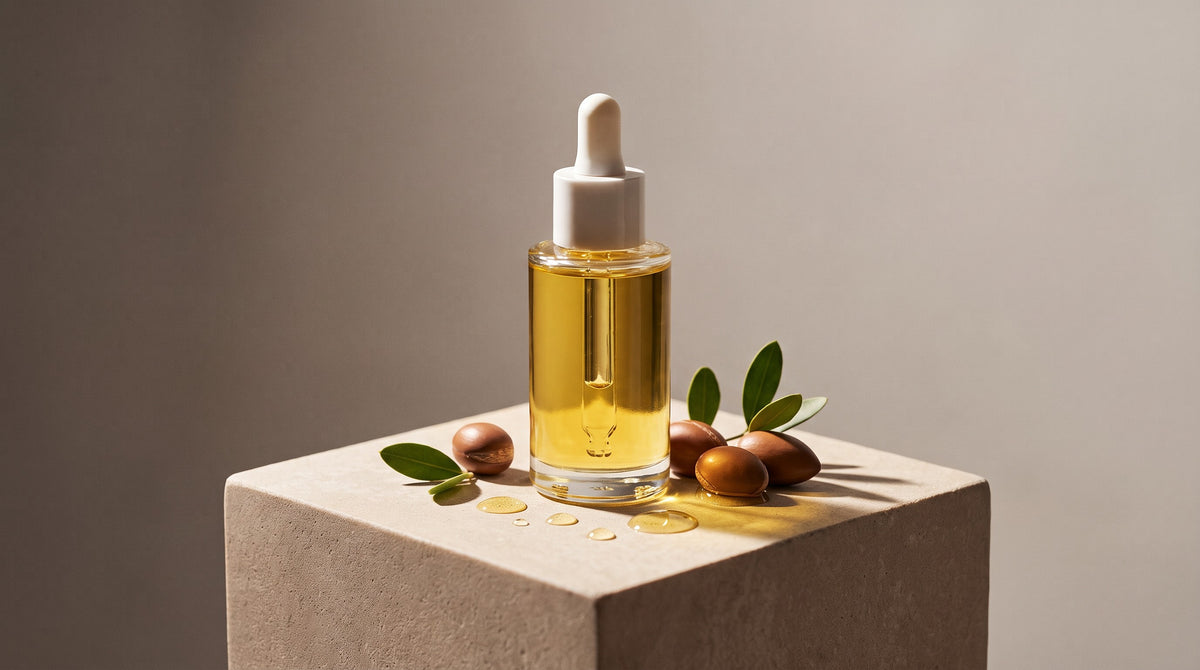
If your moisturiser stops feeling like enough somewhere around October, a face oil for dry skin is usually the missing step — not a replacement for your cream, but the layer that stops the moisture you just applied from drifting off again.
Face oils have a reputation problem. People with dry skin worry they will feel greasy; people with oily skin assume they are off-limits entirely. Both ideas come from using oils the wrong way round. Here is what a facial oil actually does, how it differs from a moisturiser, which plant oils are worth looking for, and exactly when to apply one.
What a face oil actually does for dry skin
Dry skin is short on lipids — the oily part of the skin's surface that holds everything together and slows water loss. That is a different shortage from dehydrated skin, which is short on water. A face oil is a concentrated dose of plant lipids, so it addresses the first problem directly.
In practice, a good botanical oil does three things:
- Replenishes surface lipids, so the skin barrier feels less tight and papery
- Slows water loss by sitting on top of whatever hydration is already there
- Delivers fat-soluble antioxidants such as vitamin E, which plant oils carry naturally
What a face oil does not do is hydrate on its own. Oil contains no water. Applied to bare, dry skin with nothing underneath it, an oil has very little moisture to hold in — which is why the layering order below matters more than the product you choose.
Face oil vs moisturiser: what's the difference?
The short answer: a moisturiser is mostly water with some oil in it; a face oil is all oil. They do overlapping but not identical jobs.
| Face oil | Moisturiser | |
|---|---|---|
| Mostly made of | Plant oils and lipid-soluble extracts | Water, plus oils, humectants and emulsifiers |
| Main job | Replenish lipids, seal in moisture | Add water to the skin and hold it there |
| Can it hydrate? | No — it has no water to give | Yes |
| Where it goes | Last, or mixed into the final step | After serums, before oil |
| Best for | Dry, tight, flaky, wind-exposed skin | Every skin type, every day |
So it is rarely face oil vs moisturiser. For dry skin in winter it is usually both — cream first, oil on top. The one case where an oil genuinely replaces a cream is a very rich, well-formulated oil on skin that finds even a light cream too heavy, or on a night when you want one step instead of three.
Is argan oil good for your face? And jojoba?
These are the two plant oils people ask about most, and they behave quite differently.
Argan oil is pressed from the kernels of the Moroccan argan tree. It is rich in oleic and linoleic fatty acids and naturally high in tocopherols (vitamin E), which is why it feels cushioning and suits skin that reads as genuinely dry rather than merely dehydrated. It is a classic choice for dry and mature skin, and it absorbs without the heavy film of a mineral oil.
Jojoba oil is technically a liquid wax rather than an oil, and its structure is unusually close to the skin's own sebum. That is why it tends to sit lightly, absorb quickly and suit a wider range of skin types — including skin that is dry in patches and shiny elsewhere.
Other oils worth recognising on an ingredient list:
- Avocado oil — rich and cushioning, good for skin that feels tight after cleansing
- Rosehip oil — light, with a long-standing reputation in routines focused on tone and texture
- Evening primrose and borage oils — high in gamma-linolenic acid, traditionally used in comforting formulas
- Sweet almond and apricot kernel oils — softening, mild, and easy to tolerate
- Sea buckthorn extract — a carotenoid-rich botanical that gives many oils their golden colour
Most well-made facial oils are blends rather than a single oil, because no one plant oil covers every fatty acid profile. Positine's Nourishing Facial Oil, for example, combines jojoba, argan and avocado oils with evening primrose, borage and plum oils, sweet almond and apricot kernel oils, and sea buckthorn, cloudberry, blueberry and tomato extracts. It is organic certified and vegan.
When to apply face oil in your routine
The rule is simple: thinnest to thickest, and oil goes last. Oil can pass through a water-based layer, but water cannot pass through an oil layer — so anything applied after your oil is largely wasted.
A workable evening order for dry skin:
- Cleanse. A milk or oil-based cleanser is kinder to dry skin than a foaming one — try the Gentle Cleansing Milk.
- Hydrating step. A humectant serum such as the Hydrating Serum puts water into the skin. Apply it to slightly damp skin.
- Moisturiser. A cream such as the Ceramide Hydrating Night Cream holds that water in place.
- Face oil. Two or three drops, pressed over the top, as the final seal.
Morning or night? Both work. A face oil at night has hours to do its job undisturbed, which is why most people start there. In the morning, use a lighter hand — a heavy oil under sunscreen or make-up can affect how they sit. If you only want to use one oil at one time of day, evening is the easier place to begin.
How much to use — and how to avoid a greasy finish
Almost every "face oils make me greasy" story is a dosing story.
- Two to three drops is a full face. Not a dropper-full. Start lower than feels right.
- Warm it first. Rub the drops between your palms for a few seconds so the oil thins out and spreads evenly.
- Press, do not rub. Press your palms onto cheeks, forehead and jaw. Rubbing pushes oil around and drags at the skin.
- Apply to slightly damp skin. An oil pressed over a still-damp moisturiser spreads further and absorbs faster than one applied to bone-dry skin.
- Give it two minutes. Most botanical oils look shiny on contact and settle to a satin finish shortly after. Judge the finish then, not immediately.
If you want one step rather than a layered routine — travel, late nights, minimalist by preference — a multi-use blend such as the All-In-One Facial Oil is designed to be worn alone or layered, with jojoba, olive and avocado oils, rosehip and apricot kernel oils, raspberry, oat and evening primrose oils, tomato and sea buckthorn extracts, and vitamin E.
Dry skin or dehydrated skin? It changes the answer
This distinction decides whether an oil is the right fix at all.
- Dry skin is a skin type. It produces less oil, tends to feel tight and rough, and can flake. It benefits most from lipids — which is exactly what a face oil provides.
- Dehydrated skin is a temporary state. It is short on water, can look dull and crepey, and shows up on oily skin just as often as on dry skin. It needs humectants and water first; oil alone will feel like a lid on an empty jar.
Plenty of people have both at once. If that sounds familiar, our guide to dehydrated vs dry skin walks through how to tell them apart.
Who should go carefully
Face oils suit most people, but a few caveats are worth stating plainly:
- Acne-prone skin. Oils vary widely in how well they are tolerated on congestion-prone skin. Introduce one product at a time and watch how your skin responds over a couple of weeks.
- Nut allergies. Sweet almond, apricot kernel and argan are all kernel- or nut-derived. Read the INCI list.
- Active prescription treatments. If you are using a prescribed topical, check with the prescriber before adding an occlusive layer over it.
- Essential oils. Many botanical blends are scented with essential oils. If your skin is reactive, patch test on the inner forearm first.
If you have a diagnosed skin condition, or a reaction that is not settling, speak to a pharmacist, dermatologist or other healthcare professional rather than troubleshooting it with product changes.
The short version
A face oil for dry skin is a sealing step, not a hydrating one. Put water in first, then a cream, then two or three warmed drops of oil pressed over the top. Argan suits skin that is genuinely dry; jojoba suits skin that wants something lighter. Give any new oil a fortnight before deciding — dry skin rarely turns around in a single night.
Share:
Scalp Scrub: How to Exfoliate Your Scalp — and How Often