

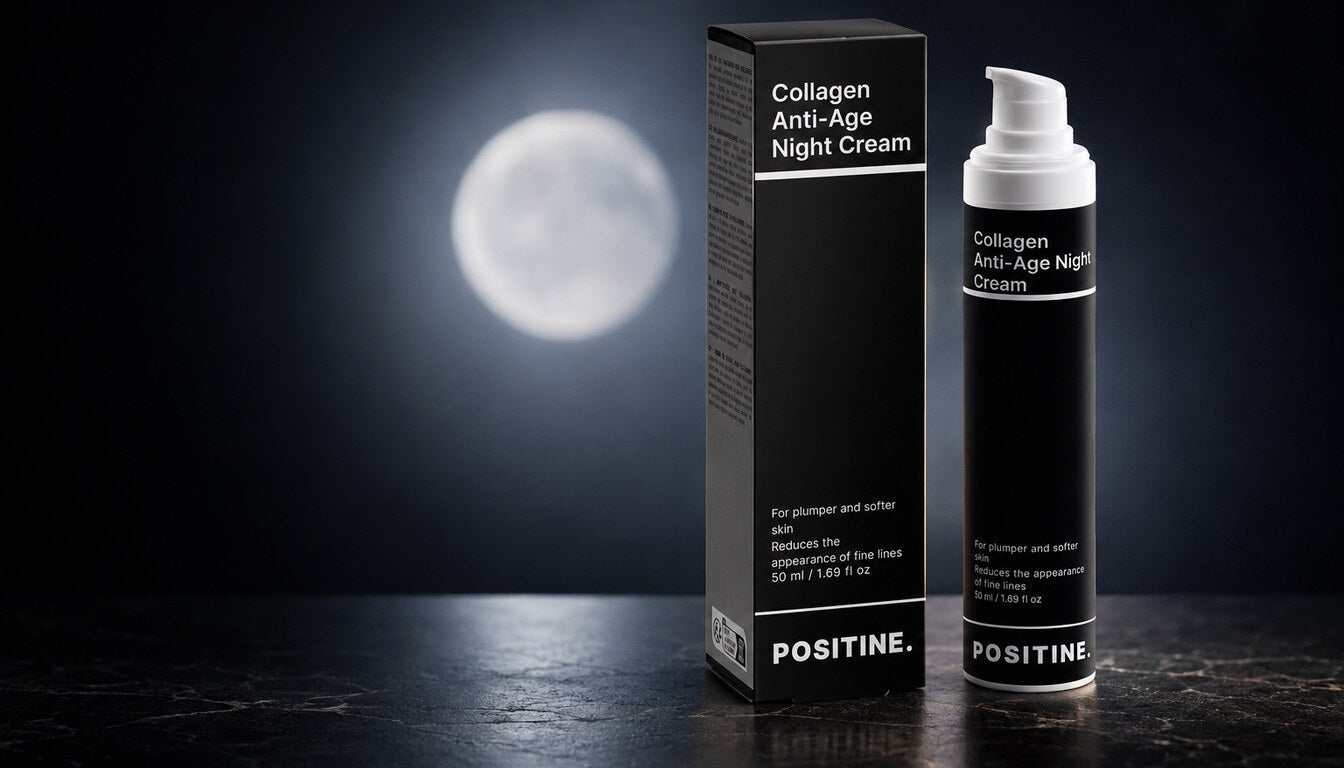
A collagen night cream can make skin feel softer, smoother and temporarily plumper, but ordinary topical collagen does not replace the collagen in the dermis. If a cream literally contains collagen, its main cosmetic role is usually surface hydration and film formation. The complete formula—not the word “collagen” on the label—determines what the product actually does.
There is a second important distinction: some products called “collagen creams” contain collagen, while others are designed to address the visible effects associated with collagen loss without containing collagen itself.
What is collagen in the skin?
Collagen is a structural protein found in the dermis, the deeper layer beneath the epidermis. It contributes to the skin’s firmness and mechanical strength. Natural collagen production and organisation change with age, while ultraviolet exposure accelerates collagen breakdown.
The collagen in your skin is made by specialised cells. It cannot simply be topped up from the outside in the same way that a moisturiser replenishes water or surface lipids.
Can collagen from a cream penetrate the skin?
Intact collagen is a large protein. Healthy skin is an effective barrier, and molecules much larger than roughly 500 daltons generally do not cross the stratum corneum easily. Collagen is far larger than this threshold, so standard collagen applied in a conventional cream is not expected to travel into the dermis and become new structural collagen.
This does not mean topical collagen is useless. When present, it can bind water and form a light film on the surface. That may reduce the appearance of dryness and make fine dehydration lines look softer for a time.
Specially engineered low-molecular collagen fragments, peptides, delivery systems or medical procedures are different categories. Their effects depend on the specific molecule and formulation and should not be assumed for every cream labelled “collagen”.
What can a collagen night cream realistically do?
1. Improve hydration
Humectants attract and hold water in the outer skin layers. Better hydration makes the surface look smoother and can temporarily reduce the visibility of fine lines caused or emphasised by dryness.
2. Reduce moisture loss
Emollients and richer lipids fill gaps between surface cells and help slow water loss. This can improve softness, flexibility and comfort, especially in dry or mature skin.
3. Create a temporary plumping effect
Well-hydrated skin reflects light more evenly and looks fuller. This is a genuine cosmetic effect, but it should not be confused with rebuilding collagen fibres inside the dermis.
4. Support the skin barrier
A well-formulated night cream can support the lipid barrier, reducing tightness and helping skin tolerate the rest of an evening routine more comfortably.
5. Deliver other useful ingredients
The strongest reason to judge a collagen cream by its full INCI list is that its moisturisers, antioxidants and other actives may be doing most of the work.
What does Positine Collagen Anti-Age Night Cream actually contain?
The published INCI list for Positine Collagen Anti-Age Night Cream does not list collagen or hydrolysed collagen. Here, “Collagen” describes the product’s firmness and anti-ageing positioning rather than a literal collagen ingredient.
Its formula instead includes:
- Alteromonas ferment extract and algae extract: marine-derived ingredients used to support a smoother, conditioned and resilient-looking skin surface.
- Shea butter, cocoa butter and sunflower oil: emollient lipids that soften skin and help reduce moisture loss.
- Glycerin, Sodium PCA and sodium hyaluronate: humectants that support hydration and temporary surface plumping.
- Aloe vera: a hydrating and soothing base ingredient.
- Olive oil unsaponifiables: lipid-rich components that support suppleness and barrier comfort.
- Ascorbyl palmitate and tocopherol: vitamin C and E derivatives that provide antioxidant support within the formula.
Therefore, the most defensible benefits are overnight moisturisation, softness, barrier support and a smoother, plumper appearance. Claims about producing new dermal collagen would require direct evidence from the finished product.
Why use it at night?
A cream does not rebuild collagen simply because it is applied at night. Night creams are usually richer because there is no need to layer makeup over them and they can serve as the final, moisture-sealing step of the evening routine.
The practical benefit is consistency: cleanse, apply a serum if used, then seal in hydration with the cream. The richer texture can remain on the skin overnight without daytime concerns about shine or cosmetic layering.
Does better hydration mean fewer wrinkles?
Hydration can make fine lines look less pronounced, especially when dryness exaggerates them. This visual improvement can occur relatively quickly. It is not the same as reversing deeper wrinkles or rebuilding the dermal matrix.
Long-term collagen preservation depends heavily on limiting UV damage. Daily broad-spectrum sunscreen is therefore more important for protecting existing collagen than any product name. Certain well-formulated retinoids and vitamin C products also have evidence related to collagen, but results depend on the exact ingredient, concentration, stability and delivery.
Who is this type of night cream best for?
A rich night cream is most likely to suit dry, dehydrated or mature skin, or anyone whose skin feels tight after cleansing. Combination or oily skin may prefer a smaller amount or less frequent use.
The Positine formula contains fragrance. If your skin is very reactive or you are sensitive to fragrance, patch-test the cream before regular use.
How to use Collagen Anti-Age Night Cream
- Cleanse the face and neck without leaving the skin tight.
- Apply any water-based serum or booster.
- Massage a small amount of night cream over the face and neck.
- Use it as the final step of the evening routine.
More product does not produce more collagen. Use enough to leave the skin comfortable, not heavily coated. In the morning, finish your routine with broad-spectrum sunscreen.
When should you expect results?
- After the first uses: softer, more comfortable and better-hydrated skin.
- With consistent use: a smoother surface and less visible dehydration lines.
- What not to expect: a conventional moisturiser physically replacing lost collagen or rapidly lifting facial contours.
Evaluate the product by hydration, comfort, texture and the visible appearance of fine dryness lines—not by the assumption that collagen from a jar becomes collagen in the skin.
The bottom line
Topical collagen, when actually present, mainly works at the surface as a moisturising and film-forming ingredient. It does not simply travel into the dermis and replace structural collagen.
Positine Collagen Anti-Age Night Cream does not list collagen in its published INCI. Its practical benefits come from marine extracts, humectants, plant butters, oils and antioxidants that hydrate, soften and support the skin barrier overnight. That is still useful skincare—just through a different and more realistic mechanism.
Frequently asked questions
Does collagen night cream rebuild collagen in the skin?
Ordinary topical collagen is too large to replace collagen in the dermis. A cream can improve hydration and smoothness, while genuine structural changes require formulation-specific evidence.
Can collagen penetrate the skin?
Intact collagen does not readily cross the healthy skin barrier. Special low-molecular fragments or delivery technologies are different and cannot be generalised to every collagen cream.
Why does skin look plumper after using a night cream?
Humectants increase water in the outer skin layers, while emollients reduce moisture loss. Better-hydrated skin looks smoother and fuller, making dehydration lines less visible.
Does Positine Collagen Anti-Age Night Cream contain collagen?
No collagen or hydrolysed collagen appears in its published INCI list. The formula uses marine ferment, algae, humectants, plant butters, oils and antioxidants to support hydration, softness and a firmer-looking appearance.
Is a night cream more effective than a day cream?
Not automatically. A night cream is usually richer and convenient as the final evening step. Its effectiveness depends on the complete formula and consistent use.
Should I use collagen night cream every night?
It can be used nightly if your skin tolerates the formula. Use a smaller amount or reduce frequency if it feels too rich or causes irritation.
Share:
Dark Spots on the Face: Causes and an Effective Skincare Routine
Niacinamide Moisturizer: Benefits, and Why a Gel Suits Oily Skin