

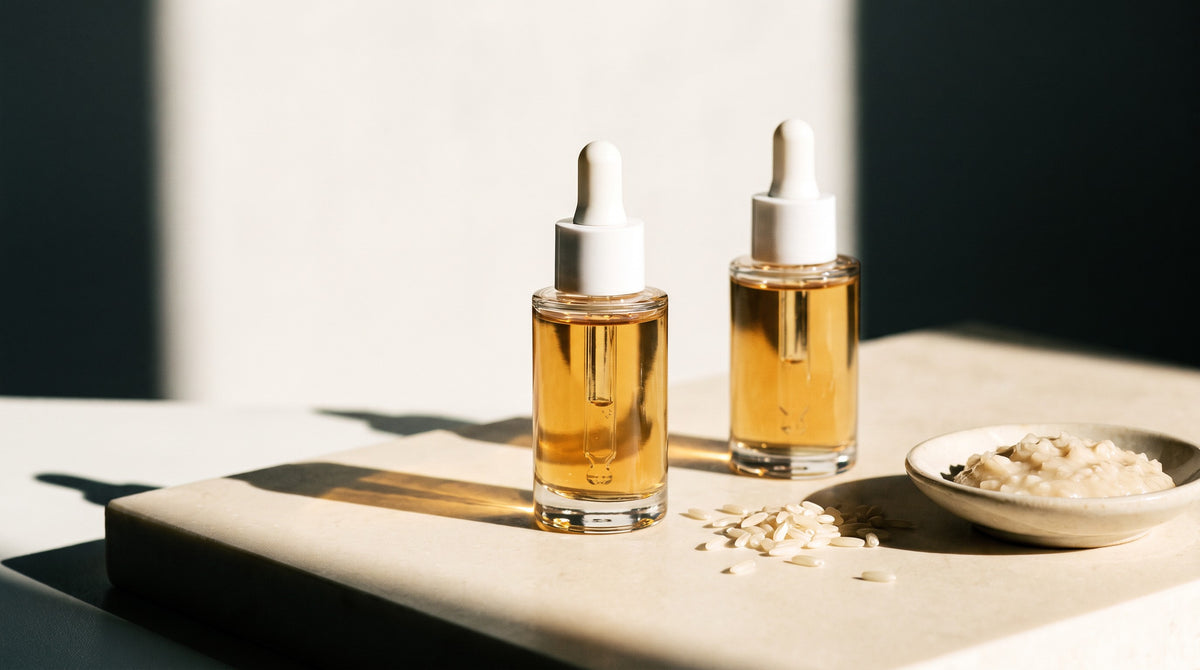
A kojic acid serum is the most direct way to use kojic acid on the skin. It is a leave-on product, so the active stays in contact with the skin for hours rather than seconds, and it can be applied precisely where pigment has built up. That makes the serum format the workhorse of most dark spot routines.
But kojic acid serums vary enormously — in concentration, in what else is in the bottle, and in how honestly they describe themselves. This guide covers what to look for, how to use one, and what to expect. If you want the background on the ingredient itself first, our complete guide to kojic acid covers the mechanism in detail.
What a kojic acid serum actually does
Pigment in skin is made by cells called melanocytes, and the rate at which they make it depends on an enzyme called tyrosinase. Sun exposure, inflammation and hormonal shifts all push tyrosinase activity up, and the excess melanin shows up as dark spots, post-acne marks and uneven patches.
Kojic acid is a tyrosinase inhibitor. It does not bleach skin, exfoliate it, or lighten your natural tone — it slows the overproduction of pigment at the point where pigment is made. That is why a serum suits it so well: the effect depends on sustained, repeated contact rather than a single intense application.
The number that matters most: concentration
If you read one thing on the label, read the percentage.
In the European Union, kojic acid is capped at 1% in leave-on face products, following the safety assessment of the EU's Scientific Committee on Consumer Safety. That 1% is not a modest dose — it is the legal ceiling, the strongest a face serum can be sold at in the EU.
The catch is that many products use the word "kojic" prominently while formulating well below that ceiling, or leaning on cheaper brightening ingredients with kojic acid far down the list. A serum that states its concentration is telling you something; one that does not, usually is too. Our Targeted Dark Spot Care Serum is formulated at the full 1%, which is as much as a kojic acid serum can legally deliver in the EU and UK.
What else should be in the bottle
Kojic acid rarely works alone. The supporting cast in a serum matters for two reasons: some ingredients complement the pigment pathway, and others keep the formula comfortable enough to use every day — which is what actually produces results.
- Vitamin C — an antioxidant that supports a brighter, more even tone through a different mechanism, and helps defend against the free-radical damage that drives new pigmentation.
- Vitamin E — works alongside vitamin C as an antioxidant and helps keep the formula stable.
- Humectants such as betaine and sodium PCA — hold water in the skin. A brightening serum that leaves skin tight and irritated is a serum you will stop using by week three.
- A light emollient such as jojoba oil — keeps the texture comfortable enough to layer under SPF or a moisturiser.
What you do not want is a long list of competing strong actives in the same bottle. Pigmentation responds to consistency, and consistency is easier when a formula is gentle.
Serum, cream or soap — which format?
The same active behaves very differently depending on how long it stays on the skin.
| Format | Contact time | Best for |
|---|---|---|
| Serum | Hours (leave-on) | Targeting specific dark spots, post-acne marks and age spots |
| Cream | Hours (leave-on) | All-over tone, combined with daily hydration |
| Soap or cleanser | Seconds (rinse-off) | Supporting a routine, not driving it |
This is the single biggest reason people are disappointed by kojic acid: they buy the rinse-off format and expect leave-on results. We covered that in detail in does kojic acid soap actually work. A serum and a daily kojic acid face cream can sit in the same routine — the serum targeting specific marks, the cream handling overall tone — and an exfoliating format adds the separate benefit of lifting away already-pigmented surface cells.
How to use a kojic acid serum
- Cleanse first. A serum applied over sunscreen or make-up residue is not reaching the skin.
- Apply to the areas that need it. A serum is a precision tool — concentrate it on the spots and patches rather than spreading a thin film everywhere.
- Morning, evening or both. Kojic acid is gentler than retinoids or AHA exfoliants, so daily use is reasonable. Start once a day and build up if your skin is comfortable.
- Follow with moisturiser. Comfortable skin is skin you keep treating.
- Finish with SPF every morning — without exception. Kojic acid increases photosensitivity, and UV exposure is one of the main drivers of the pigment you are trying to fade. Using a brightening serum without daily broad-spectrum sun protection is emptying a bucket with the tap still running.
One more principle: introduce it on its own. If you start a kojic acid serum at the same time as two other new actives and your skin reacts, you will have no idea which one to blame.
Kojic acid compared with other brightening actives
| Active | How it works | Notes |
|---|---|---|
| Kojic acid | Inhibits tyrosinase, slowing excess melanin production at source | Well tolerated across the full range of skin tones; capped at 1% in EU leave-on face products |
| Alpha arbutin | Also targets tyrosinase, released more gradually | A slower, gentler route — often suits skin easing into brightening actives |
| Vitamin C | Antioxidant supporting brightness and defending against free-radical damage | Complementary rather than a substitute; a natural fit for morning routines under SPF |
| Niacinamide | Works further along the pathway, on the transfer of pigment to skin cells | Generally layers comfortably alongside other actives |
| Hydroquinone | A potent tyrosinase inhibitor | Not permitted in EU cosmetics; where available it is typically prescription-led and time-limited |
These are not really rivals. Most effective pigmentation routines combine a leave-on inhibitor, an antioxidant and daily SPF — introduced one at a time.
What results actually look like, and when
Pigment fades on the skin's own timetable, and no serum changes that. With consistent daily use, most people see visible change in the range of 8 to 12 weeks. Recent, superficial marks move faster than deep, long-established spots.
It helps to think in two phases. A treat phase — the first 8 to 12 weeks of daily use, bringing existing pigmentation down. Then a maintenance phase — a lighter rhythm of a few times a week, holding the result and staying ahead of new pigment.
Whether you can stop altogether depends on the cause. Post-acne marks often fade and stay faded. Sun-related spots tend to return with new UV exposure unless maintained. Melasma is chronic and hormonally influenced — it is managed over the long term rather than cured, and is worth discussing with a dermatologist.
Who should be cautious
At EU cosmetic concentrations, kojic acid is considered safe for general use. Two notes are worth keeping in mind: some people experience mild irritation when starting, so a patch test and a gradual introduction are sensible; and kojic acid has not been extensively studied in pregnancy, so if you are pregnant or breastfeeding, check with your doctor before starting any new active. If you are treating a diagnosed skin condition, speak to a healthcare professional rather than relying on cosmetic products alone.
Frequently asked questions
What does a kojic acid serum do?
It slows the overproduction of melanin by inhibiting the enzyme tyrosinase, which helps fade dark spots, post-acne marks, age spots and uneven tone. It does not exfoliate, thin the skin, or change your natural skin colour.
What percentage of kojic acid should a serum have?
In the EU and UK, 1% is the maximum permitted concentration in leave-on face products, so a serum formulated at 1% is delivering as much as it legally can. Many products sit well below that without saying so.
Can you use a kojic acid serum every day?
Yes. Kojic acid is gentler than retinoids or AHA exfoliants, and daily use through the initial treat phase is what produces results. Start once a day, build up if comfortable, and always pair it with daily SPF.
How long does a kojic acid serum take to work?
Most people see visible change in 8 to 12 weeks of consistent use. Recent surface marks fade faster than deeper, older pigmentation.
Can you use kojic acid and niacinamide together?
They act at different points in the pigment pathway and generally layer comfortably together. As always, introduce one new active at a time so you can tell how your skin responds.
Kojic acid or alpha arbutin — which is better for dark spots?
Both inhibit tyrosinase. Alpha arbutin releases more gradually, which can suit skin that is easing into brightening actives; kojic acid acts more directly. Neither is universally better — consistency and daily SPF matter more than the choice between them.
Does a kojic acid serum work on the body?
The active behaves the same way on body skin, but body skin is thicker and pigment there is often slower to shift. For larger areas, an exfoliating or cream format is usually more practical than a precision serum.
Share:
Glycolic Acid vs Salicylic Acid: AHA or BHA for Your Skin?
Scalp Scrub: How to Exfoliate Your Scalp — and How Often