

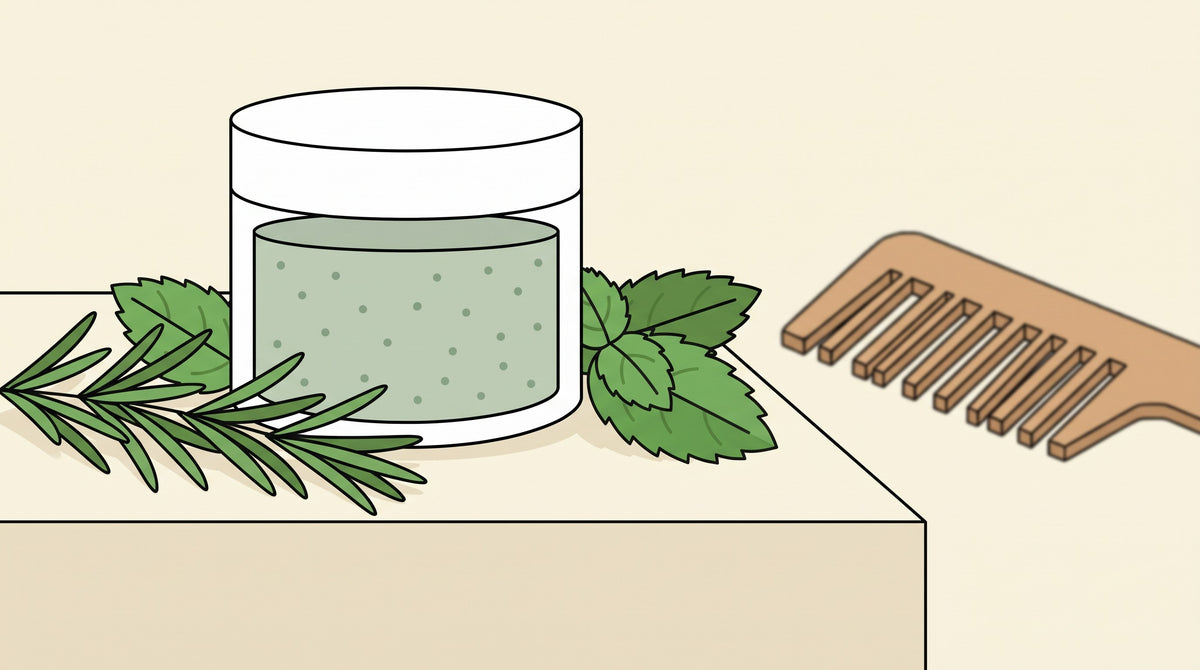
You wash your hair, and by the next afternoon the roots already look flat and feel slightly heavy. Lengths are fine. Ends are fine. The problem is higher up — at the scalp, where styling product, sebum and hard-water minerals quietly collect between washes.
That is the gap a scalp scrub is designed to close. This guide covers what scalp exfoliation actually does, how to use a scalp scrub without irritating your skin, how often is sensible, and the claims worth being sceptical about.
What is a scalp scrub?
A scalp scrub is a pre-shampoo treatment that exfoliates the skin on your head. It combines fine physical exfoliants with cleansing and conditioning ingredients, and you massage it into a wet scalp before your usual shampoo.
The scalp is skin. It sheds dead skin cells, produces sebum and responds to what you put on it in the same way the skin on your face does. The difference is that it is covered in hair, so buildup is harder to see and easier to ignore — and shampoo, which is formulated mainly to lift oil from hair fibres, does not always clear it.
Positine's Deep Cleanse Scalp Scrub, Rosemary & Mint is a typical example of the format: fine cherry shell powder and kaolin clay do the physical lifting, rosemary and peppermint oils give the scalp a cooling, invigorating finish, and hydrolyzed keratin with shea butter condition the hair so cleansing does not leave it stripped.
Why product buildup collects on the scalp
Scalp buildup is rarely one thing. It is usually a combination of:
- Styling product residue — dry shampoo, texturising sprays, mousses and waxes are formulated to cling, which is exactly why they are not fully removed by a quick wash.
- Sebum — the scalp's own oil, which is helpful in moderation and heavy when it accumulates.
- Dead skin cells — shed continuously, and easily trapped at the root by oil and product.
- Hard water minerals — calcium and magnesium deposits that leave hair feeling coated and dull in many regions.
The visible result is familiar: roots that look dull, volume that collapses within a day, and a scalp that feels tight, heavy or itchy even though you washed recently.
What scalp exfoliation can — and cannot — do
Being honest about the ceiling here matters, because scalp scrubs are marketed with a lot of enthusiasm.
What it can do: remove product residue and loose flakes, cut through oil at the root, make hair feel lighter and cleaner from the root, and leave the scalp more comfortable. Many people also find their shampoo and conditioner perform better afterwards, simply because they are working on a clean surface rather than through a layer of residue.
What it cannot do: treat a medical scalp condition, permanently stop oil production, or change the density of your hair. If flaking, redness or itching is persistent, recurring or painful, that is a conversation for a doctor or dermatologist — seborrhoeic dermatitis and psoriasis need proper treatment, not a cosmetic scrub.
Physical vs chemical scalp exfoliation
Two broad approaches exist, and they suit different scalps.
| Physical scrub | Chemical exfoliant | |
|---|---|---|
| How it works | Fine particles lift residue as you massage | Acids loosen the bonds between dead skin cells |
| Typical ingredients | Cherry shell powder, kaolin clay, sugar or salt | Salicylic acid, glycolic acid, lactic acid |
| Best for | Product buildup, oily roots, a heavy-feeling scalp | Persistent flaking, very fine or dense hair where massaging is awkward |
| Watch out for | Over-scrubbing and coarse particles | Stinging on an already irritated or broken scalp |
| Feel | Immediate, tactile, satisfying | Gradual, invisible while it works |
Particle size is what separates a good physical scrub from an uncomfortable one. Coarse grains drag against the scalp; fine, evenly milled powders like cherry shell lift residue without that scratching sensation.
How to use a scalp scrub, step by step
- Start on wet hair, before shampoo. Part the hair into sections so the scrub reaches the scalp instead of sitting on the lengths.
- Apply at the roots. Work it directly onto the scalp — the hair fibres are not the target.
- Massage with fingertips, not nails. Small circular movements, light pressure, one to two minutes. Pressure is not what lifts buildup; contact and movement are.
- Let it sit. Positine's scrub is designed to be left on for 5–15 minutes, which gives the clay time to absorb excess oil.
- Rinse thoroughly, then shampoo. Rinse until the water runs clear, then wash as usual. Skipping the rinse is the single most common reason hair feels heavier after a scrub, not lighter.
- Condition mid-lengths to ends only. Keep conditioner away from the scalp you have just cleared.
How often should you use a scalp scrub?
Once or twice a week suits most people, and that is the frequency Positine recommends for its own scrub. Beyond that, the useful rule is to match frequency to how quickly buildup returns:
- Oily scalp, daily styling products, frequent dry shampoo: twice a week.
- Normal scalp, occasional styling: once a week.
- Dry, tight or easily irritated scalp: once every week or two, and stop if the scalp feels sensitised.
- Coloured hair: once a week is plenty, and give fresh colour a few days to settle first.
More is not better. A scalp that feels tight, itchy or unusually oily after exfoliating is a scalp being over-cleansed — space the treatments further apart rather than adding more.
Scalp scrubs for oily, dry and flaky scalps
Oily scalp. This is where scrubs are most immediately satisfying. Clay-based formulas absorb surface oil as well as lifting residue, and roots stay clean-feeling for longer between washes.
Dry scalp. Exfoliation can still help, but the formula matters more. Look for conditioning ingredients — shea butter, fatty-acid-rich oils, hydrolyzed keratin — so you are not simply stripping an already dry scalp. Go gently and less often.
Flaking. Cosmetic flaking caused by product residue or dryness usually responds well. Flaking that is greasy, yellowish, persistent or accompanied by redness and itching is more likely to be a skin condition, and should be assessed by a healthcare professional rather than scrubbed away.
Does a scalp scrub help hair growth?
This is the claim to treat most carefully. There is no good evidence that exfoliating your scalp makes hair grow faster or thicker. Hair growth is driven largely by genetics, hormones, health and age — not by how clean the surface of your scalp is.
What exfoliation does do is create a cleaner, more comfortable environment at the root, and remove the residue that makes fine hair look flatter than it is. Hair can certainly look fuller after a scrub. That is a cosmetic result, and it is worth having on its own terms — but it is not new growth.
Five mistakes worth avoiding
- Scrubbing harder. Pressure irritates the scalp; it does not clean it better.
- Using it on dry hair. Water disperses the product and cushions the friction.
- Under-rinsing. Residue left behind defeats the entire point.
- Exfoliating an already irritated scalp. Wait until any soreness, broken skin or sunburn has healed.
- Expecting it to replace shampoo. A scrub is a pre-wash step, not a substitute for one.
What to pair it with
A scalp scrub works best as the reset at the start of a routine rather than a standalone fix.
- After the scrub: follow with a shampoo suited to your hair goal — Keratin Volume Boost Shampoo if flat roots are the concern — and keep conditioner on mid-lengths and ends.
- Between washes: a scalp-focused oil such as the Rosemary Hair & Scalp Strengthening Oil nourishes the scalp on non-exfoliation days.
- On the day itself: give yourself the extra ten minutes. The leave-on time is doing real work.
Frequently asked questions
Can I use a scalp scrub on coloured hair?
Generally yes, once a week, applied at the roots rather than raked through the lengths. Wait a few days after a fresh colour service.
Should I use a scrub before or after shampoo?
Before. Exfoliate first, rinse, then shampoo to remove everything that has been loosened.
Can I use one if I have dandruff?
A scrub may help with the cosmetic flaking that sits on the surface, but it is not a dandruff treatment. Persistent dandruff is a medical matter and benefits from a proper diagnosis.
Will it make my hair greasy?
Not if it is rinsed out properly and followed with shampoo. Greasiness afterwards almost always points to an incomplete rinse.
How long before I notice a difference?
The lighter, cleaner feeling is usually immediate. Whether roots stay fresher for longer between washes is the thing to judge over three or four weeks.
This article is for general information and is not medical advice. If you have a persistent scalp condition, hair loss or a skin complaint, please consult a doctor or dermatologist.
Share:
Kojic Acid Serum: How to Choose One — and How to Use It
Face Oil for Dry Skin: How to Use One (and When It Beats a Moisturiser)