

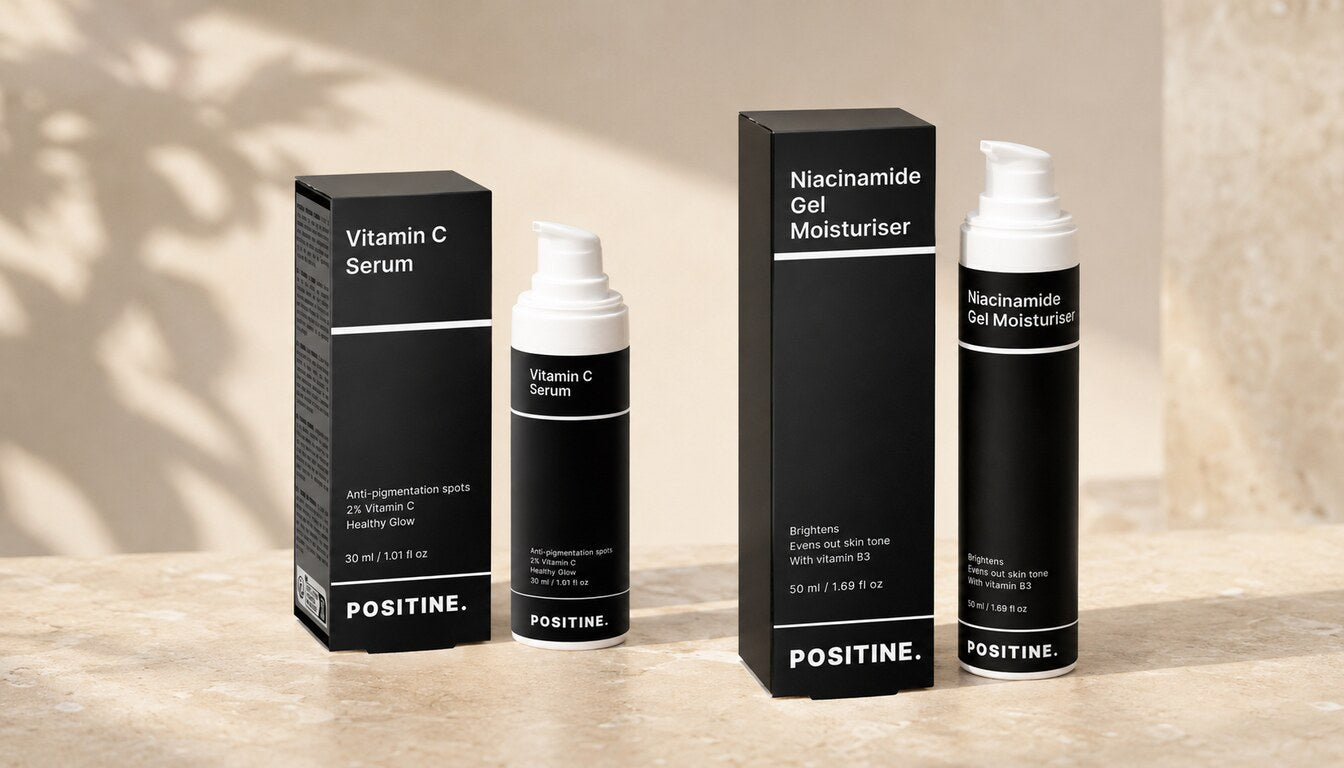
Yes — vitamin C and niacinamide can be used together. There is no practical need to keep these two ingredients apart in a modern skincare routine. They address complementary concerns, and the correct order depends mainly on the texture and role of each product.
With the Positine products, the order is straightforward: apply the Vitamin C Serum first, follow with the Niacinamide Gel Moisturiser, and finish the morning routine with broad-spectrum sunscreen.
What do vitamin C and niacinamide each do?
Vitamin C
Vitamin C is an antioxidant used to support a brighter, more even-looking complexion and help protect the skin from oxidative stress caused by environmental exposure. It also plays a role in normal collagen synthesis.
Positine Vitamin C Serum contains 2% vitamin C in the form of ascorbyl glucoside, a stabilised derivative, together with ferulic acid, vitamin E, humectants and botanical oils. It is designed as a lightweight serum for morning use.
Niacinamide
Niacinamide is a form of vitamin B3. In skincare, it is used to support the skin barrier, improve moisture retention and help the appearance of uneven tone, enlarged pores and excess oil. It is generally well tolerated across different skin types.
Positine Niacinamide Gel Moisturiser contains 5% niacinamide with ginkgo biloba, glycerin and algin in a lightweight moisturising gel.
Why do some people think they should not be combined?
The advice to avoid using vitamin C with niacinamide is largely based on theoretical formulation concerns and harsh laboratory conditions that do not reflect ordinary use of finished skincare products. The idea that the two ingredients automatically cancel each other out is not a useful rule for a modern routine.
What matters more is the individual formula, the total number of active products in the routine and how your own skin responds. Even compatible ingredients can feel irritating if several new products are introduced at the same time.
How to use vitamin C and niacinamide together
- Cleanse. Use a gentle cleanser and pat the skin dry.
- Apply vitamin C serum. Use 1–2 pumps of Positine Vitamin C Serum over the face and neck.
- Let the serum settle. Continue once the skin no longer feels wet; there is no need to wait for a fixed number of minutes.
- Apply niacinamide moisturiser. Smooth a small amount of Positine Niacinamide Gel Moisturiser over the face and neck.
- Finish with sunscreen. In the morning, apply broad-spectrum SPF as the final skincare step.
The order follows texture: serum first, moisturiser second, sunscreen last. There is no need to mix the two products together in your palm.
Should you use them in the same routine or at different times?
Most people can use both in the same morning routine. Separating them may be useful if:
- your skin is highly reactive;
- you are introducing both products for the first time;
- your routine already includes exfoliating acids or a retinoid;
- you notice persistent stinging, redness or dryness.
In that case, use vitamin C in the morning and niacinamide in the evening, or introduce one product for several days before adding the other. The goal is not to avoid an ingredient combination; it is to identify what your skin tolerates comfortably.
Which skin concerns can this pairing support?
- Dull or uneven-looking tone: both ingredients are commonly used in routines focused on visible brightness and tone.
- Oily or combination skin: niacinamide can support a more balanced appearance, while the gel texture remains lightweight.
- Dehydrated skin: both Positine formulas contain additional humectants that support moisture.
- Early signs of environmental stress: the antioxidant components complement a daily sunscreen routine.
Neither product replaces sunscreen, and neither should be expected to change the skin overnight. Consistent use and a simple routine matter more than adding more active ingredients.
Common mistakes to avoid
- Applying too much of both products. Thin, even layers are sufficient.
- Introducing several actives at once. Add new products one at a time if your skin is sensitive.
- Mixing products in the hand. Layering makes the amount and order easier to control.
- Treating tingling as proof that a product works. Persistent burning or redness is a reason to stop, not a sign of better results.
- Skipping sunscreen. A brightening routine is incomplete without daily UV protection.
How long does it take to see results?
The moisturising effect and skin feel may improve sooner, while visible changes in tone, texture or the appearance of pores generally require consistent use over several weeks. Results vary with skin type, the rest of the routine and sun exposure.
If you are still deciding how to position vitamin C in your routine, read our practical guide: Vitamin C Serum: How to Use It Correctly.
Frequently asked questions
Can vitamin C and niacinamide be applied at the same time?
Yes. They can be layered in the same routine if your skin tolerates both products.
Which goes first: vitamin C or niacinamide?
Apply the lighter serum first and the moisturiser second. With Positine products, Vitamin C Serum goes before Niacinamide Gel Moisturiser.
Do vitamin C and niacinamide cancel each other out?
No. There is no practical reason to assume that modern finished products automatically neutralise each other when layered normally.
Can sensitive skin use both ingredients?
Often yes, but introduce one product at a time or separate them between morning and evening if your skin is reactive.
Should this combination be used in the morning or evening?
Either is possible. Morning use is convenient because vitamin C fits well into an antioxidant routine followed by sunscreen.
Can vitamin C and niacinamide be used with retinol or exfoliating acids?
They can be part of the same overall routine, but using too many active products together may increase irritation. Separate them by time or day if needed.
A simple Positine morning routine: Vitamin C Serum → Niacinamide Gel Moisturiser → broad-spectrum sunscreen.
Share:
Vitamin C Serum: How to Use It Correctly
Dark Spots on the Face: Causes and an Effective Skincare Routine