

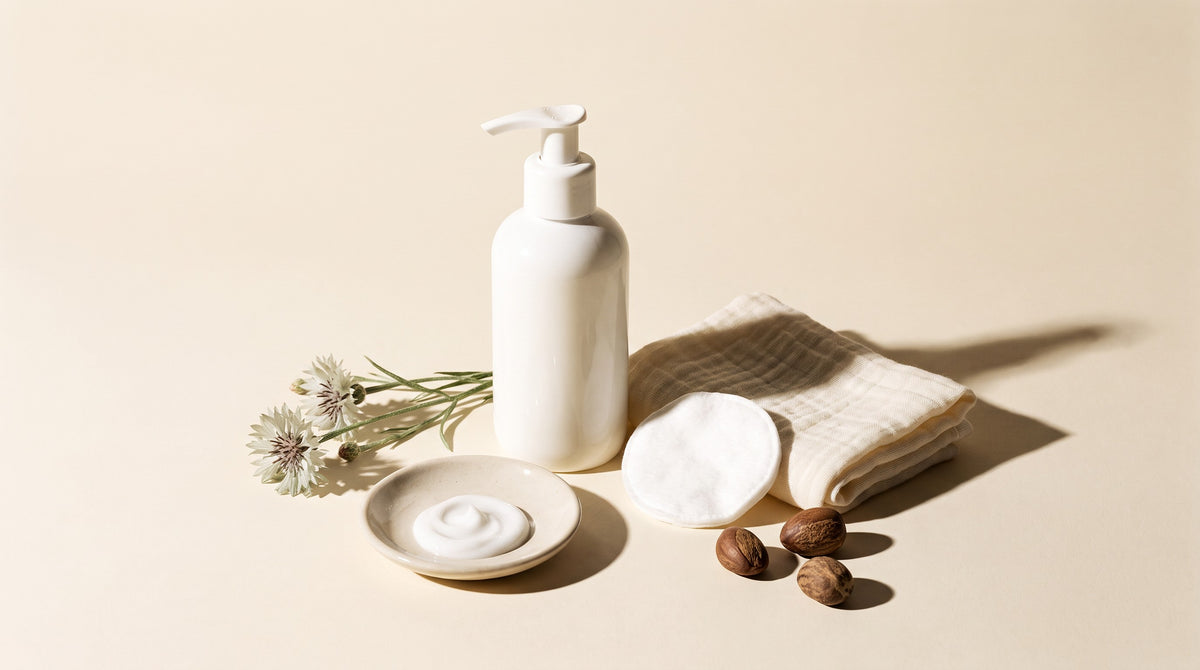
Cleansing milk is one of the quietest products in skincare and one of the most misunderstood. It does not foam, it does not tingle, and it rarely makes bold promises. That is exactly the point: a milk cleanser is built to remove make-up, sunscreen and the day's grime without stripping the skin barrier that everything else in your routine depends on.
What is cleansing milk?
A cleansing milk is a lightweight oil-in-water emulsion — a small amount of nourishing oil dispersed through a water base, which is what gives it that opaque, milky look and its silky slip. Instead of relying on strong surfactants to lift oil away, it works on the principle that like dissolves like: the oils in the formula bind to the oils on your skin, including make-up and sunscreen, so they can be wiped or rinsed off together.
Because the surfactant load is low, a milk cleanser leaves far more of the skin's own lipids in place than a foaming gel does. There is no squeaky-clean feeling afterwards — and that is a feature, not a shortfall. That tight, squeaky sensation is usually a sign that a cleanser has taken more than it needed to.
Cleansing milk vs gel, foam, balm and micellar water
Every cleanser format is a different compromise between cleansing power and gentleness. Here is where a milk cleanser sits:
| Format | How it works | Best suited to |
|---|---|---|
| Cleansing milk | Low-surfactant oil-in-water emulsion; dissolves make-up and SPF, rinses or wipes off | Dry, dehydrated, sensitive and mature skin; anyone whose skin feels tight after washing |
| Gel or foam | Surfactant-led; lifts oil and sweat away in water | Oily and blemish-prone skin, or as a second cleanse |
| Cleansing balm or oil | Anhydrous oils and waxes that melt on contact and emulsify with water | Heavy or long-wear make-up, layered SPF |
| Micellar water | Micelles in water that attract oil and grime; typically no-rinse | Light make-up, quick resets, travel |
If you want to go deeper on the last one, we have written a separate guide on what micellar water is and how to use it.
Who cleansing milk is for
A cleansing milk earns its place if any of the following sound familiar:
- Your skin feels tight after cleansing. This is the clearest signal that your current cleanser is too strong for your barrier.
- You have dry or dehydrated skin. A milk cleanser cleans without removing the lipids that keep water in the skin.
- Your skin is easily irritated. Fewer and gentler surfactants mean less disruption. Our routine guide for sensitive skin covers how to build the rest of the steps around it.
- Your skin is mature. Skin produces fewer lipids over time, so a cleanser that replaces some of what it removes is worth having.
- You wear make-up most days. A milk cleanser removes it properly without needing a second, harsher wash.
Cleansing milk is a less obvious choice if your skin is very oily or actively congested. In that case, a milk cleanser still works well in the evening as a first cleanse to take off make-up and SPF, followed by a lighter second cleanse.
How to use a cleansing milk
- Start on dry or slightly damp skin. Dry skin lets the oils in the formula reach make-up and sunscreen directly; a little water makes it glide more easily.
- Massage for 30–60 seconds. Use gentle, circular motions. This is the step most people rush, and it is the step that does the work.
- Rinse or wipe. Rinse with lukewarm water, or remove with a soft cloth or cotton pad — both are correct, and the choice is down to preference and water hardness.
- Follow while skin is still damp. Apply your toner, serum and moisturiser before the skin fully dries so you are sealing in water rather than chasing it.
Morning and evening both work. If you only want to use it once a day, make it the evening, when there is make-up and SPF to remove.
What to look for in the ingredient list
A well-built milk cleanser tends to combine three things: emollient oils that do the dissolving, humectants that hold water in the skin, and calming botanical extracts. Our Gentle Cleansing Milk is formulated on that structure:
- Shea butter, argan and avocado oils — rich in fatty acids that replenish and soften, and help strengthen the skin's barrier.
- Jojoba oil — closely mimics the skin's own sebum, which is why it cleanses without leaving a heavy film.
- Sunflower seed oil — lightweight nourishment that soothes and smooths.
- Cornflower and peony extracts — calm signs of sensitivity and restore comfort.
- Glycerin and lactic acid — help retain moisture while gently refining texture.
If you prefer a texture that starts as an oil and transforms on contact with water, the Sensitive Skin Oil-To-Milk Cleanser does the same job in a different format. For a fast, no-rinse option on low-effort days, Micellar Cleansing Water is the lighter alternative.
Common questions
Does cleansing milk actually remove make-up?
Yes. The oils in the emulsion dissolve make-up and sunscreen, which is precisely how balms and oils work too. For heavy, long-wear or waterproof make-up, give it a longer massage or use a dedicated remover first.
Do you have to rinse cleansing milk off?
Not necessarily. Most milk cleansers, including ours, can be rinsed with water or removed with a cloth or cotton pad. Rinsing leaves the lightest finish; wiping suits hard water and very reactive skin.
Is cleansing milk good for oily skin?
It can be, as a first cleanse in the evening. Oily skin that has been over-cleansed often behaves better on a gentler routine, but if congestion is your main concern, pair it with a second cleanse or an exfoliating step rather than relying on the milk alone.
Can you use cleansing milk every day?
Yes — twice a day if you like. Gentleness is what makes it suitable for daily use.
The short version
A cleansing milk is the option to reach for when your skin needs to be clean but not stripped. It removes make-up and sunscreen through oils rather than strong detergents, leaves the barrier intact, and suits dry, sensitive and mature skin particularly well. If your current cleanser leaves your face feeling tight, swapping it is one of the smallest changes in skincare with one of the most noticeable results.
This article is general information about cosmetic products, not medical advice. If you have a persistent or worsening skin concern, speak to a pharmacist, doctor or dermatologist.
Share:
How to Apply Eye Cream: Order, Amount and When to Start