

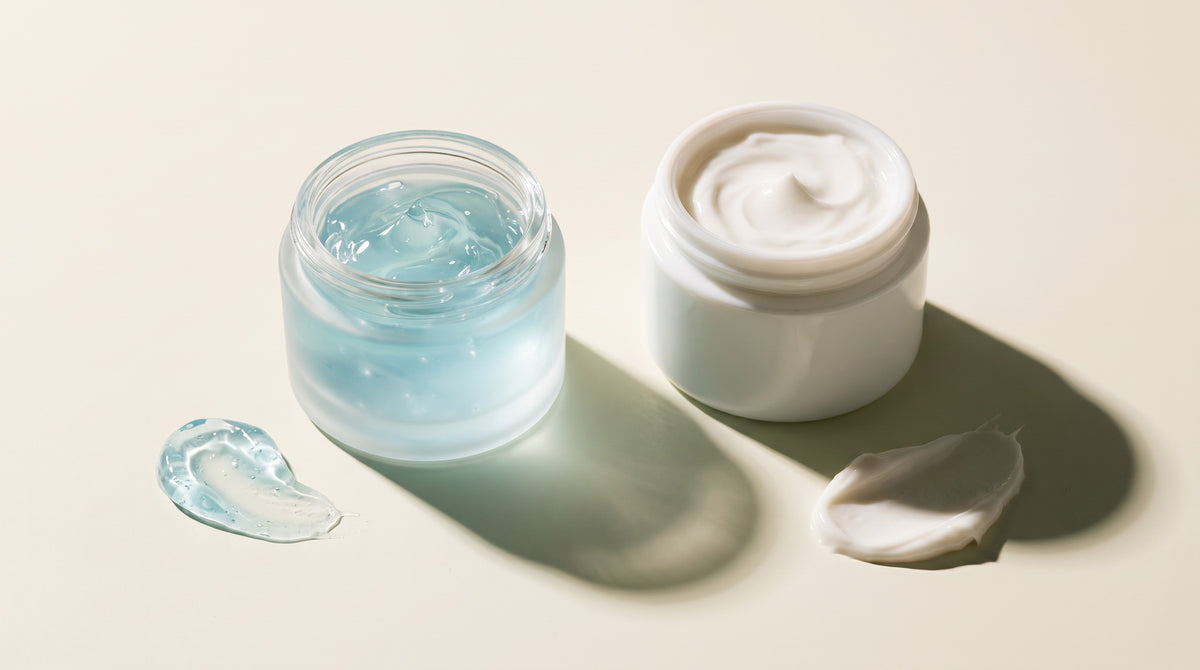
Gel Moisturizer vs Cream: What's Actually Different?
Walk along any skincare shelf and the same product category comes in two very different textures. One is a clear, bouncy, almost water-like gel moisturizer. The other is an opaque, thicker cream. They are often sold on the same promise — hydration — but they get there in different ways, and they suit different skin.
The short version of the difference between a gel and a cream moisturizer: a gel is mostly water with humectants dispersed through a light gelling system, while a cream is an emulsion of water and oils or butters. A gel delivers water. A cream delivers water plus the lipids that hold it in. Which one your skin needs depends on whether it is short of water, short of oil, or both.
| Gel moisturizer | Cream moisturizer | |
|---|---|---|
| Base | Water-based, little to no oil | Water-and-oil emulsion |
| Works mainly by | Humectants binding water (hyaluronic acid, glycerin, betaine) | Humectants plus emollients and occlusives that seal |
| Finish | Fresh, matte to satin, absorbs fast | Cushioned, satin to rich, sits longer on skin |
| Best for | Oily, combination, blemish-prone, dehydrated skin; humid weather; under make-up or SPF | Dry, mature, barrier-compromised skin; cold or windy weather; overnight |
| Weak point | Little occlusion — hydration can escape if nothing seals it | Can feel heavy and may not suit very oily or congestion-prone skin |
What a Gel Moisturizer Actually Does
A gel moisturizer is a water based moisturizer. Strip it back and you have water, humectants, a gelling agent that gives the bouncy texture, and usually soothing or balancing botanicals. There is no heavy butter or thick oil phase, which is why it disappears into the skin in seconds and leaves no film.
That makes a lightweight moisturizer of this type useful in three situations in particular:
- Oily or combination skin that still feels tight. This is dehydration, not dryness — the skin is short of water, not oil. A rich cream can feel suffocating here while doing nothing for the actual deficit.
- Warm or humid conditions. When there is moisture in the air and your own sebum is running high, you need less occlusion, not more.
- Under make-up or sunscreen. A gel sets quickly and does not pill or slide the way a heavy cream can.
A hyaluronic acid gel moisturizer is the most common version, because hyaluronic acid is a humectant — it binds water in the upper layers of the skin and visibly plumps it. Our Double Hydration Boost Gel is built this way: hydrolysed hyaluronic acid together with sodium hyaluronate, so hydration lands at more than one level rather than sitting on the surface, alongside organic aloe vera juice, white tea and sage leaf extracts, and glycerin with sodium PCA to hold moisture in place.
Where skin is oily and also blemish-prone, a gel can carry a balancing active instead. The Oil-Free Hydrating Gel pairs sodium hyaluronate and aloe vera with zinc PCA, which helps regulate sebum; the Niacinamide Gel Moisturiser uses 5% niacinamide with ginkgo biloba to refine the look of texture and pores. Both are gels for the same reason — the skin needed water and clarity, not lipids. If that is your situation, the longer read on niacinamide gel moisturizers for oily skin goes deeper.
What a Cream Moisturizer Does Better
A cream earns its place when the barrier itself needs support. Its oil phase supplies emollients that soften and smooth, and occlusives that slow water loss from the skin's surface. Humectants alone cannot do that second job — draw water in with nothing over the top and a good deal of it simply leaves again, which is the single most common reason people conclude hyaluronic acid "doesn't work" for them.
Creams suit:
- Genuinely dry skin — a skin type that produces less oil, often lifelong, and shows it as flaking and a rough feel across the whole face.
- Mature skin, where lipid production has slowed.
- Cold, dry or windy weather, and heated or air-conditioned rooms.
- Night-time, when there is no make-up or SPF to layer over and comfort matters more than a matte finish.
For a daytime cream that still feels light, our Moisturising Day Cream combines multi-molecular hyaluronic acid with aloe vera and berry antioxidants. Overnight, the Ceramide Hydrating Night Cream leans on ceramides with shea butter and jojoba oil — the lipid side of the equation, reinforcing the barrier while you sleep. Reactive or easily reddened skin often does best with a fragrance-free option such as the Sensitive Skin Moisturiser, which pairs aloe vera, jojoba oil and hyaluronic acid without added fragrance.
Is a Gel Moisturizer Good for Dry Skin?
On its own, usually not enough. Dry skin lacks oil, and a gel has very little to give. You can apply a generous layer and still feel tight an hour later, because the water you added had nothing holding it there.
That does not make a gel useless for dry skin — it makes it the wrong last step. Used underneath a cream or a facial oil, a gel is an excellent hydration layer: it puts water in, and the cream over it keeps it in. The order matters more than the choice. If you have dry skin and like the fresh feel of a gel, treat it as the serum-adjacent step, not the finish.
The flip side is worth saying plainly too: oily skin can be dehydrated, and dry skin can be well hydrated. Oil and water are separate questions. If you are not sure which describes you, our guide to dehydrated skin versus dry skin has a simple at-home check.
Gel-Cream: The Middle Ground
A gel cream moisturizer sits between the two. It is still an emulsion, so there is an oil phase and some sealing capacity, but the proportions are tuned so it breaks down to a light, almost gel-like slip on application rather than a cushioned film.
This is the pragmatic choice for combination skin, for anyone whose needs shift between seasons, and for people who find true gels leave them tight but creams leave them shiny by midday. If you have only ever tried one extreme and disliked it, the middle is worth testing before you decide moisturizer texture is not for you.
When to Use a Gel Moisturizer — and When to Switch
Rather than picking one forever, match the texture to the conditions:
- Summer, humid climates, exercise-heavy weeks: gel, morning and evening.
- Winter, heated indoor air, long flights: cream in the evening at minimum, often both ends of the day.
- Morning under SPF: gel, with the sunscreen doing part of the sealing work.
- Evening after an exfoliating acid or a retinol alternative: cream, to buffer and support recovery.
- Breakouts or congestion: gel, and look for zinc PCA or niacinamide rather than richer emollients.
- Visible flaking, stinging, tightness that will not settle: cream, and simplify the rest of the routine until the barrier calms.
A reasonable default for most people: gel in the morning, cream at night, and adjust by season rather than by trend.
Can You Use a Gel Moisturizer and a Cream Together?
Yes, and for a lot of skin it is the best answer. The principle is thinnest to thickest, water-based before oil-based:
- Cleanse, then tone if you use a toner — try our Hydrating Toner.
- While skin is still slightly damp, apply the gel and press it in rather than rubbing.
- Give it 30–60 seconds to settle.
- Seal with a cream, or a facial oil if your skin runs very dry.
- Sunscreen last, in the morning.
Two cautions. Do not stack three moisturizing products hoping for a bigger effect — past a point you are adding weight, not hydration. And if you are introducing a new active at the same time, change one thing at a time, so that if skin reacts you know what caused it.
Choosing Your Texture: A Quick Summary
- Oily, combination or blemish-prone, and skin feels tight: a gel — Oil-Free Hydrating Gel or Niacinamide Gel Moisturiser.
- Normal to dry, want hydration without weight: a hyaluronic acid gel such as the Double Hydration Boost Gel.
- Dry or mature, want light daytime comfort: Moisturising Day Cream.
- Barrier needs rebuilding, or overnight repair: Ceramide Hydrating Night Cream.
- Sensitive or easily reddened: Sensitive Skin Moisturiser, fragrance-free.
Final Thoughts
Gel versus cream is not a question of which is better formulated. It is a question of what your skin is short of, and in what conditions. Water deficit calls for humectants in a light base; lipid deficit calls for emollients and occlusives; many people have both and are best served by a gel underneath a cream. Once you think in those terms, the shelf gets much easier to read.
If tightness, flaking, stinging or persistent congestion does not improve with a simple, gentle routine, it is worth speaking to a pharmacist, dermatologist or other qualified professional — skin that stays uncomfortable can have causes that a change of moisturizer texture will not address.
Share:
Cleansing Milk: What It Is, Who It's For, and How to Use It